New Book by Nicole P. Marwell and Jennifer E. Mosley Challenges the Role of Randomized Controlled Trials in Nonprofit Evaluation
By Crown Family School
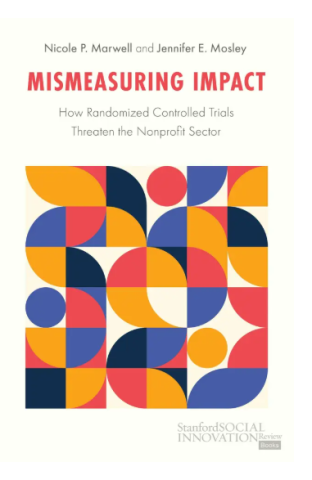
A new book co-authored by University of Chicago Crown Family School of Social Work, Policy, and Practice faculty members Nicole P. Marwell, PhD and Jennifer E. Mosley, PhD offers a critical examination of the widespread use of randomized controlled trials (RCTs) to evaluate nonprofit programs.
In Mismeasuring Impact: Why Randomized Controlled Trials Can’t Solve the Problems of the Nonprofit Sector, Marwell and Mosley reveal why randomized controlled trials (RCTs), often called the “gold standard” for social program evaluation, are poorly suited to the nonprofit sector. Marwell and Mosley show how the challenges of implementing RCTs in nonprofits undermine their core strengths of innovation and responsiveness. The book provides practical alternatives for utilizing evaluation to enhance nonprofit performance.
Drawing on extensive interviews with nonprofit leaders, professional evaluators, and philanthropic program officers, the authors provide firsthand accounts of how RCTs can distort the purpose and practice of nonprofit work. Instead of fostering organizational learning and community responsiveness, RCTs often demand standardization and conformity, sidelining the innovative and adaptive strengths that define many effective nonprofit organizations.
Marwell and Mosley argue that randomized controlled trials (RCTs) frequently fall short of their own methodological standards and are often used to reinforce the legitimacy of nonprofits rather than to support organizational improvement. As a result, time, staff capacity, and financial resources may be diverted away from mission-driven work and toward evaluation efforts that offer limited actionable insight.
Mismeasuring Impact also examines the equity concerns that arise when nonprofits, particularly those that are smaller or community-based, feel pressured to undertake costly, resource-intensive evaluations to meet funder expectations. In response, the authors propose alternative approaches that elevate organizational resilience, center community engagement, and align with the values of the nonprofit sector.
Presenting a thoughtful critique grounded in extensive research, Mismeasuring Impact invites readers to reconsider how effectiveness is defined and measured in nonprofit settings, and to envision evaluation strategies that genuinely support meaningful, community-informed impact.